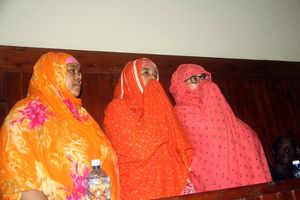
Josephine Sionda Ramoya, 48, says she has been living in hiding for eight months after a campaign of threats and an abduction.

What you need to know:
- Josephine Sionda Ramoya, a 48-year-old grandmother, has been abducted, assaulted and repeatedly threatened since January after her family pushed for justice for the late Sharon Otieno.
- Despite reports to police stations in Nairobi, Mombasa, Eldoret and Kisumu, no arrests have been made and no suspects questioned.
NAIROBI—For the past eight months, Josephine Sionda Ramoya has lived shifting from one part of the country to another. When home, blacked-out curtains and a near permanently closed door are her lifestyle.
What began as a series of unexplained unknown calls in late January quickly escalated into a calculated campaign of terror. Josephine, a 48-year-old grandmother, has documented mysterious threatening calls, suspicious people following her and even a kidnap and attack that left her with physical injuries. Yet, despite making reports to various police stations, she remains entirely unprotected.
“Every time I visit the police station to make a report, I am dismissed and leave feeling like I’m committing a crime by wasting their time,” Josephine said, her voice trembling as she rejects an unknown call that comes in as she narrates her story—a routine she repeats dozens of times a day. “They told me that they cannot do anything against orders from above, their hands are tied.”
An Escalating Campaign
The harassment took a dark turn in May when Josephine was accosted in the evening and bundled into a van. Inside the van there were three men and the driver. During the one hour she was kidnapped in the van, she was physically assaulted and beaten. She was left with a broken nose. Among the men in the van, she could identify one of her old neighbours in Korogocho slum. She was convinced that the sender knew her schedule, her habits, and her moves.
Josephine Sionda Ramoya in hospital after the May attack that left her with a broken nose.
Josephine filed her first official police report on February 23rd. According to copies of the reports obtained by this newspaper, the responding officer classified the incident as a “civil neighbourhood dispute,” despite Josephine living alone and having no ongoing conflicts with her neighbours.
Over the next seven months, Josephine logged separate reports to various police stations in Mombasa, Eldoret, Nairobi and Kisumu. She provided investigators with security camera footage showing a masked figure loitering on her compound at 3:00 AM, alongside screenshots of threatening messages and repeated unknown number call logs.
No arrests have been made. No suspects have been questioned.
Orders from above
Josephine believes her assailants work for the embattled Migori governor Okoth Obado. She believes that her troubles started after the death of Sharon Otieno. Sharon was a close cousin of Ramoya’s son-in-law. As a family they were deeply engaged in trying to make sure that justice is delivered to the family of Sharon by sharing bits of evidence that Sharon had shared with the son-in-law.
This, she believes, did not sit well with the Sangwenya. Sangwenya is a political network of loyalists or hired goons, operating notably in Migori, used to hype crowds, defend politicians, suppress political dissent, and sometimes cause chaos or violence. They have been known to work for the governor Obado.
The son-in-law, who was a cousin and a confidant to the late Sharon, had faced similar tribulations. He was assaulted, and his business in Migori burnt down by people suspected to be Sangwenya operatives. When the heat got too much, he fled the country with his family. This left Josephine exposed and thought to be the easiest target remaining.
This reveals a culture of dismissiveness regarding complaints where people in power are suspected to be engaging in criminal activities. In one exchange in July after her alleged abduction, she says a female police officer confided in her that they understand her plight but their hands are tied. She claimed that Josephine is playing too close to the fire and she will be burnt.
Living in Limbo
With no intervention from local authorities, Josephine has spent thousands of shillings of her own money on frequent relocations and private security on a need basis. She is no longer able to have any meaningful economic activity outside the house since she cannot tell when, where and how the next attack will come.
For Josephine, the lack of police action sends a clear, terrifying message to both victims and perpetrators.
“The person doing this to me knows the police won’t do anything,” Josephine said. “The law is essentially telling my assailants that he has a green light until he decides to finish the job. I’m just waiting for the worst to happen.”
By Peter Onyango